
👥 Unit 1: Early Civilisations
Sub unit 4: The Aztecs civilisation
- Period and Founding: The Aztec Empire flourished from 1345 to 1521. It was founded by Montezuma I in 1440, who took over from Itzcoatl and united several states.
- Origin and Location: The Aztecs were a nomadic hunter-gatherer tribe who moved from Northern Mexico to settle in the central region (modern-day Mexico).
- Capital City: Their main city, Tenochtitlan, is the location of modern-day Mexico City.
- Rise to Power: They dominated the region and conquered other states due to their superior social, political, religious, and trading organization. They superseded the earlier Toltec civilisation.
Key Strengths (Factors for Success):
- Language: Their superior language, Nahuatl (which contributed words like chocolate and avocado to English), helped them easily integrate other groups.
- Agriculture: They reclaimed swampy land to grow staple crops like maize, beans, potatoes, and avocados. This reliable food supply sustained their large population and army. They also hunted, fished, and gathered.
- Leadership and Military: Strong leadership, including Montezuma I and his predecessor Itzcoatl, enabled them to form a powerful military alliance (with the Texcocans and Tacubans) to defeat powerful rivals like Teponac. Their warriors had superior armour and weapons.
- Religion and Culture: Their religion attracted many people. They built magnificent temples to gods like Huitzilopochtli (sun/war god) and Quetzalcoatl. Their culture featured a complex calendar system based on solar (365 days) and ritual (260 days) cycles.
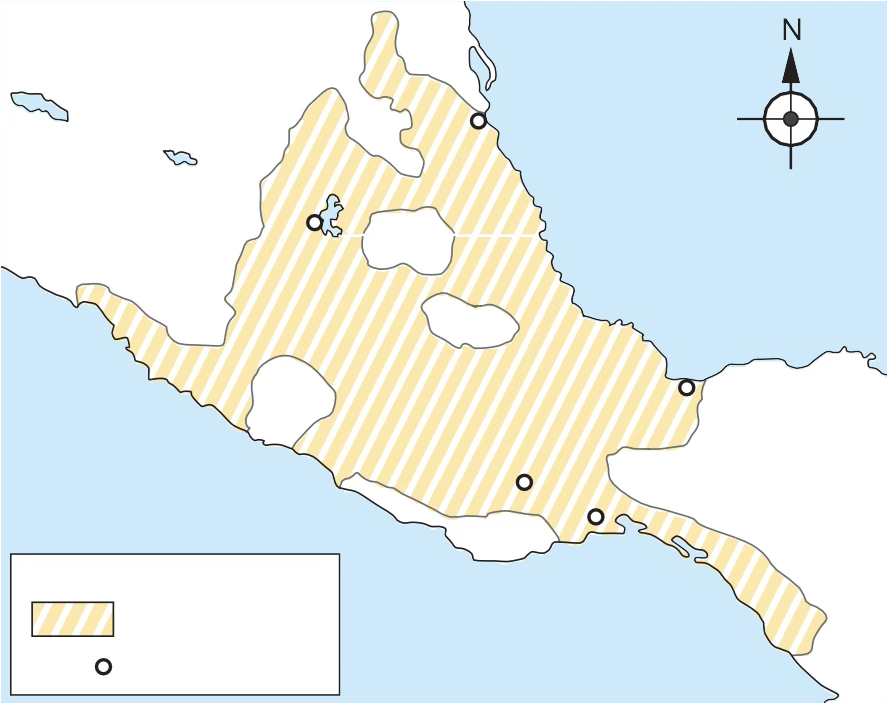
Fig 1.9: Map of Aztec Empire
The characteristics of Aztec civilisation
- The Aztec spoke the language known as Nahuatls which was superior in the region at that time.
- They had a religion which united them and was based on astronomy and celestial events. They performed human sacrifice to appease their gods.
- They had a strong military which fought their enemies and helped in the expansion of the Empire.
- There were magnificent buildings in their cities and towns.
- The Aztecs had a calendar which helped them to mark religious events and also guided them in crop cultivation.
- They had irrigation system which helped in plantation farming.
The achievements of Aztec civilisation
- In Aztec Empire, education was compulsory to all. Education started at home and extended to schools where a number of subjects were provided to learners from adolescence age.
- They built a strong empire in Mesoamerica by waging wars of conquest using their strong army against their enemies and expanding their territories.
- They were great engineers whose works are seen in the construction of pyramids and the causeways through water to link Tenochtitlan city and the mainland without necessarily using a boat to cross through.
- In the mid-15th century, the island city of Tenochtitlan faced a severe crisis due to rising water levels that threatened to sweep it away. To protect the city from the danger of flooding and sinking, the Aztecs engineered a great masterpiece: a dyke constructed around the city's perimeter.
- The physicians of Aztec known as Ticlis used their herbal knowledge to cure diseases as well as performing surgeries on patients.
- Aztecs were good poets who could organise for contests to develop their talents. The most popular literature was poetry. They also sung in festivals.
- They used their craft talents to curve sculptures which were used in the palace and worship places.
The Artifacts of Aztecs’ civilisation
The most familiar artifact of the Aztec civilisation is the Aztec calendar stone carved from basalt and was used for more than 300 years.
Aztec feather shield has also been found. It is a shield decorated with feather tassells hanging down and a feather fringe around.
Montezuma’s throne was an artifact discovered in 1831. It was where the king sat when discharging his duties in the palace.
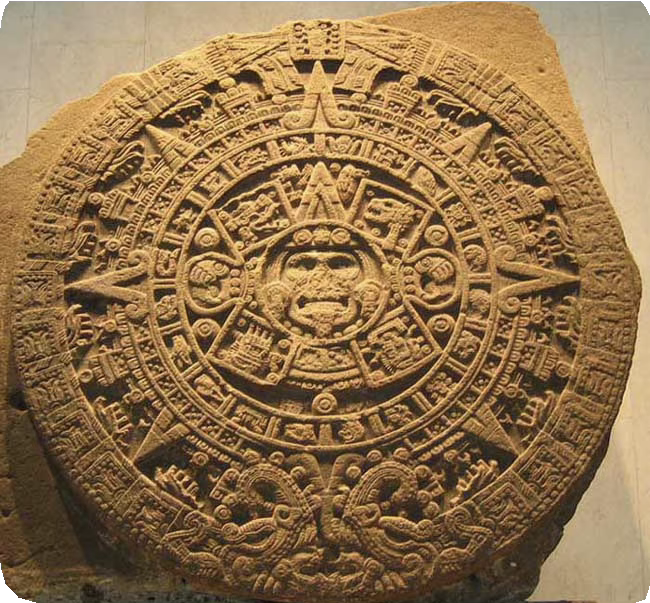
Fig 1.10: Aztec calendarwho sat on it had both
Another artifact found was Mictlantecuhtli statue which was made of clay. This was a statue of the god of death and earth.
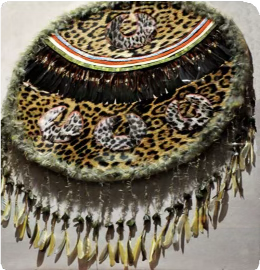
Fig 1.11: Aztec feather shield
The contributions of Aztec to art
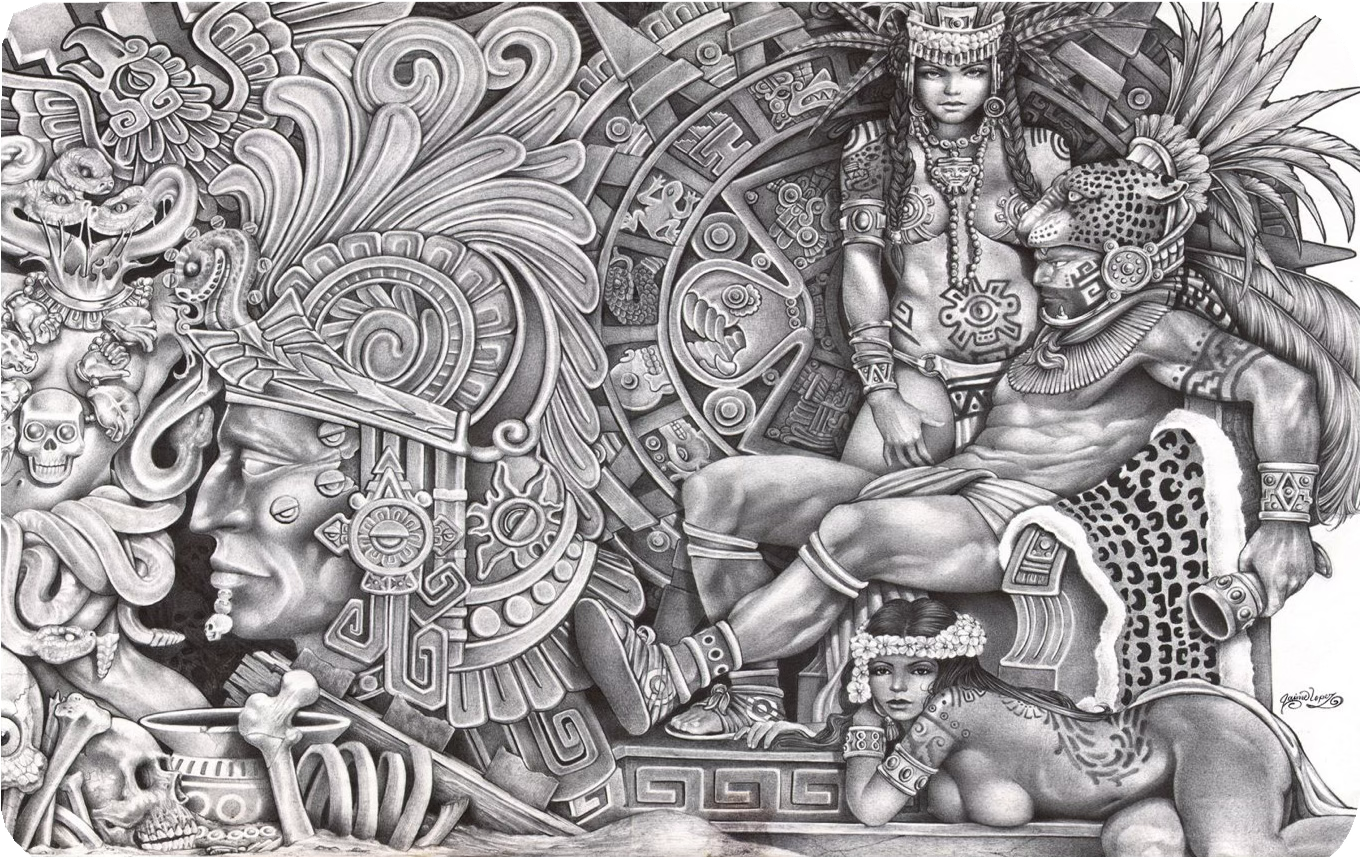
Source 1.4 Art using Aztec imagery Look at the Aztec art above. Identify the symbols you can see in this art. What do you think the symbols you named above represent?Name the graphical symbols in the above art that are still used today.
Aztec’s contributions in Science and Technology
- Agriculture (Irrigation): They developed a terrace irrigation system to ensure continuous crop production throughout the year.
- Medicine: They discovered and used antispasmodic medicine to prevent muscle spasms and relax muscles. This type of medicine is still used today to treat conditions like insomnia, high blood pressure, and epilepsy, as well as in surgeries.
- Education: They enforced mandatory education for all citizens.
- Architecture/Building: They were skilled builders, constructing magnificent houses and splendid buildings, especially in their capital city of Tenochtitlan (modern-day Mexico City).
- Identify examples of Aztec influence on modern art.
- How do you think the modern artists have interpreted the ancient symbols?
The fall of Aztecs
- Initial Contact (1517): The decline began when Francisco Hernandez de Cordoba, sailing from Cuba, arrived in Mexico.
- The Spanish Arrival: The Spanish Governor, Diego Velasquez, sent a larger force led by Commander Hernán Cortés.
Cortes's Strategy:
- Cortés learned about the great Aztec Empire, ruled by Montezuma II.
- With the help of a native translator, Malinche, Cortés marched inland.
- He secured crucial assistance from Aztec enemies, such as the Tlascalans, to help conquer the empire.
Montezuma II's Downfall:
- Cortés was initially received with honour because he resembled the god Quetzalcoatl, fulfilling a prophecy.
- The Aztec nobles and military were attacked.
- Montezuma II was captured and later died while imprisoned.
Final Battle (1521):
- After Montezuma's death, his nephew Cuauhtémoc took over and briefly managed to drive the Spanish out.
- Cortés organized a final counter-attack, defeating the Aztecs and ending their empire in 1521.