
👥 Unit 1: Early Civilisations
Completion requirements
Sub unit 1: Early civilisations in Ancient Egypt
-
Evolution and development of Egyptian civilisation
- Period and Duration: Ancient Egyptian civilisation, ruled by dynasties of kings/pharaohs, began around 3100 BCE with King Narmer and lasted for over 3000 years, ending in 30 BCE with the death of Cleopatra VII.
- Influence: This early civilisation (3100 BCE – 30 BCE) influenced other early civilisations, including those in Greece and Rome.
- Structure and Growth: The civilisation grew through a series of stable kingdoms, separated by periods of instability.
- Pinnacle of Power: Egypt reached its greatest power during the New Kingdom, particularly under the Ramesside reign, where it rivalled the Hittite, Assyrian, and Mitanni Empires.
- Decline and Foreign Conquest: Following its peak, Egypt entered a slow decline and was conquered by various foreign powers, including Canaanites, Libyans, Persians, and Macedonians.
- Ptolemaic Kingdom: After Alexander the Great's death, his general Ptolemy Soter established the Greek Ptolemaic Kingdom, which ruled Egypt from 305 BCE until 30 BCE.
- End of Independence: The Ptolemaic Kingdom fell to the Roman Empire, and Egypt became a Roman province in 30 BCE.
- Key to Success (Nile): Success was partly due to adapting to the Nile River Valley's conditions for agriculture; the predictable flooding and controlled irrigation produced surplus crops.
- Impact of Surplus: Surplus crops supported a dense population, social development, and culture, allowing the administration to sponsor mineral exploitation.
Other Success Factors:
Success also stemmed from: - The early development of an independent writing system.
- The organization of the collective structure and agricultural projects.
- Trade with neighbours and military efforts to defeat enemies and assert Egyptian dominance
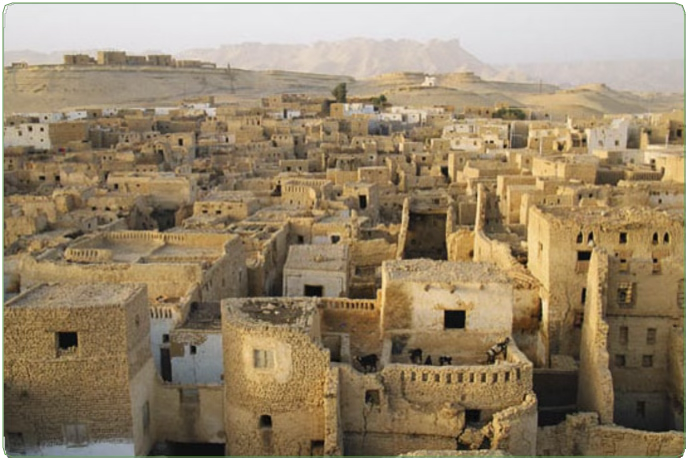
Fig 1.1: Ancient Egyptian town
WORK TO DO
We have learnt that civilisation involves cultural transformation. Which aspects of culture are influenced by the development of civilisation?The achievements of the Egyptian civilisation
Construction and Engineering: - Period and Duration: Ancient Egyptian civilisation, ruled by dynasties of kings/pharaohs, began around 3100 BCE with King Narmer and lasted for over 3000 years, ending in 30 BCE with the death of Cleopatra VII.
- Developed advanced quarrying, surveying, and construction techniques.
- These techniques supported the building of monumental structures like pyramids, temples, and obelisks.
Science and Technology: - Established a system of mathematics.
- Developed a practical and effective system of medicine.
- Innovated irrigation and agricultural production techniques.
- Advanced in shipbuilding techniques.
- Pioneered Egyptian faience(decorative pottery) and glass technology.
Culture and Diplomacy: - Created new forms of literature.
- Authored the earliest known peace treaty (with the Hittites).
Legacy and Influence: - Left a lasting legacy in art and architecture, which was widely copied.
- Egyptian antiquities were spread globally.
- Its monumental ruins have inspired travellers and writers for centuries.
Modern Appreciation: - A newfound respect for Egyptian antiquities in the early modern period by Europeans and Egyptians led to scientific investigations of the civilisation and a greater appreciation of its culture.
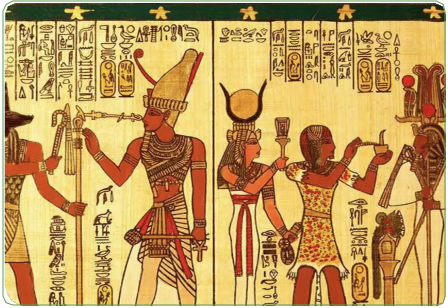
Fig 1.2: A Pharaoh’s painting
Source 1.1
The Egyptian tombs contained biographical texts. Many were just self-praising but others were real records of the tomb owner’s achievements. ‘His Majesty sent me to Hatnub in order to bring a great altar of travertine of Hatnub. I brought this altar down for him in 17 days. After it had been quarried at Hatnub, I had it transported downstream in the barge that I had made for it, a barge of acacia wood of 60 cubits in length and 30 cubits in width. It was built in 17 days and in the third month of summer, when there was no water on sandbanks, it was safely moored at the pyramid of King Merenre.’(A text found on the walls of Hatnub quarries in Middle Egypt)
ACTIVITY
Study the above source and answer the following questions.
Study the above source and answer the following questions.
- What are the key messages the writer is trying to convey?
- What do you think was the importance of writing texts on pyramid walls?
The decline of Egyptian civilisation
- The decline of Egyptian civilisation began around 1100 BCE.
- Pharaoh Ramses III led a costly war, an attempt to conquer Syria, which severely depleted Egypt's treasury.
- In 945 BCE, Egypt was conquered and came under the rule of a succession of various foreign powers.
- This foreign conquest marked the definitive decline of the great Egyptian civilisation.