
👥 Unit 1: Early Civilisations
Sub unit 5: The Inca civilisation
- Duration and Scope: The Inca civilisation lasted for over 100 years, occupying a vast region stretching from Northern Ecuador to Central Chile. It encompassed over 12 million inhabitants and more than 100 ethnic groups.
- Mythical Origin: According to mystical theory, the Inca were created by the sun god, Inti.
- Inti sent his son, Mancocapac, to Earth.
- Mancocapac settled near Cusco around 1200, after leading his followers to kill his brothers.
Expansion and Conquest:
- The eighth emperor, Viracocha Inca, expanded the Inca state.
- He defeated the Ayarmaca kingdom to the south and took control of the Urubamba Valley.
- Viracocha achieved this conquest with the help of his two uncles and his strong military skill.
Maintaining Control: To maintain peace in the newly conquered lands, Emperor Viracocha established military garrisons in those areas.
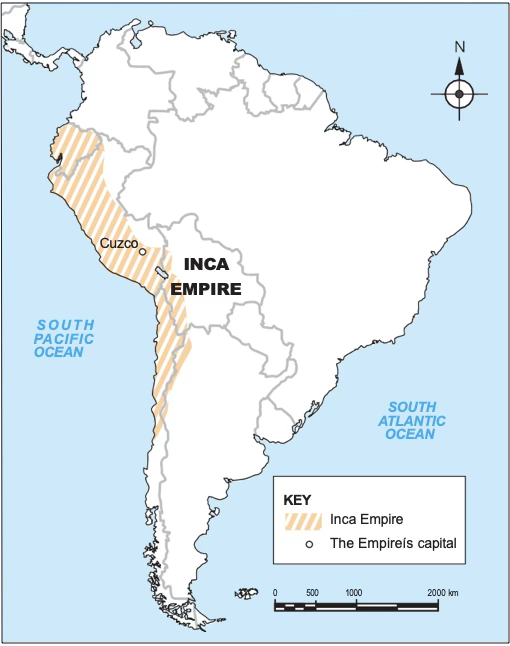
Fig 1.12: Map of the Inca Empire and the neighbouring states
Pachacuti's Rise to Power (1438):
- The Incas were attacked by the Chancas, causing the emperor Viracocha Inca to retreat.
- His son, Inca Yupanqui, successfully defended against the invasion, leading him to assume the title Pachacuti and become one of the most influential rulers.
Imperial Expansion and Unification:
- Pachacuti transformed the Inca state into the largest empire in Central America, expanding it further southwards.
- To prevent uprisings among the diverse population (over 100 ethnic groups), Pachacuti ordered a forced resettlement to strengthen and grow the kingdom.
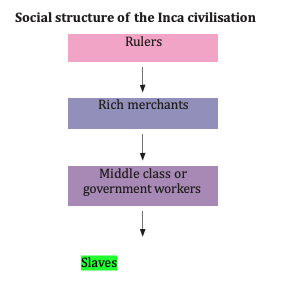
Social Structure: The Empire maintained an elaborate social hierarchy:
- Top: Rulers
- Middle: Rich merchants
- Lower: The poor
- Bottom: Slaves (conquered from other states)
- These strict social strata facilitated the smooth operation of the Empire.
Cultural and Administrative Unity:
- The Incas were united by a common language, the dialect known as Quechua, spoken by approximately 12 million inhabitants.
- They kept accounting records and historical tracks using knotted cords called Quipu, which was also essential for education.
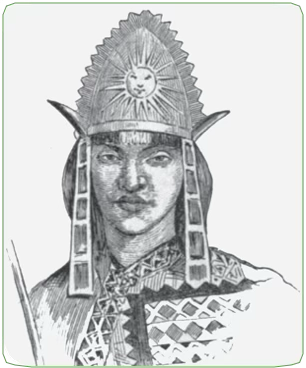
Fig 1.13: Pachacuti Yapanqui
Road Network and Communication:
- The Incas possessed good road networks.
- These roads were primarily used by runners or messengers to relay information throughout the vast kingdom and to other states.
Religion and Unification:
- Religion was a unifying force that supported the empire's growth.
- Key gods included Inti (the creator god/sun god) and Apu Illapu (the rain god).
- Priests conducted services in magnificent temples, particularly in the capital city of Cusco.
Ancestor Worship:
- The bodies of former emperors were mummified and held sacred by the Inca people.
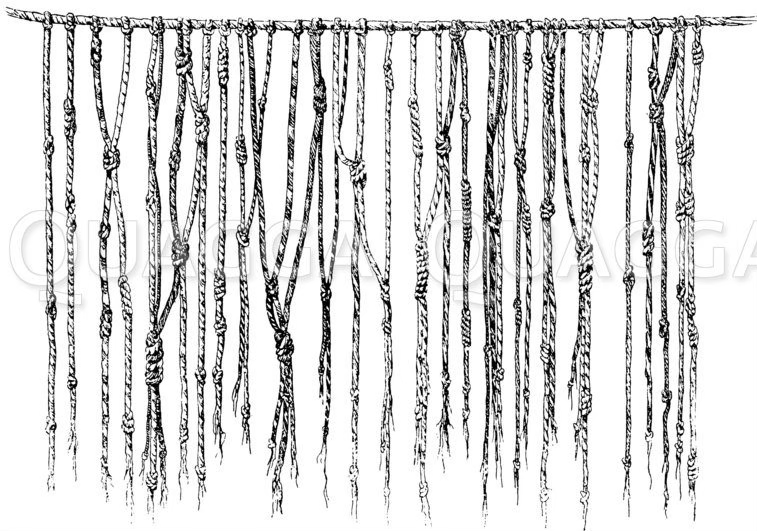
Fig 1.14: A Quipu
The characteristics of the Inca civilisation
- The Inca civilisation was centred at the capital Cusco which served as the nerve centre. The Empire was so expansive that it covered six modern day countries of Columbia, Argentina, Ecuador, Chile, Peru and Bolivia.
- The Empire had a structured political system headed by an Emperor. The Emperor was assisted by local rulers who controlled the many ethnic tribes in the region.
- The Inca spoke Quechua language which helped to unite the entire Empire.
- The Incas also had an elaborate religious life observing various practices led by priests. They had a family of gods whom they prayed to.
- The Incas were agriculturalists who planted food crops and kept livestock for their livelihood.
- They also hunted and gathered as well as fishing from the rivers and lakes.
- They were also good craftsmen as they did perfect weaving, pottery and basketry for which they were famous.
- They practiced human sacrifice. The victims were willing people and were treated as gods before the sacrifice.
The achievements of the Inca civilisation
Engineering and Transportation (Roads and Bridges):
- Built an extensive road system through collective, manual labour, connecting the capital, Cusco, to the rest of the empire.
- Constructed paved roads and suspended bridges across difficult terrain using natural fibres.
- Used llamas and alpacas as their means of transport.
Agriculture and Food Security:
- Developed an elaborate irrigation system using carved rock and clay canals to water crops, ensuring food throughout all seasons.
- Practiced soil erosion control by cutting hills into flat, terraced farmland.
- Agriculture was the core of the economy, supplemented by hunting, gathering, and fishing.
- Surplus food was stored in facilities called Collcas to prevent hunger.
Economic System (Labour and Trade):
- Operated without money or markets, using a barter system for trade among villages (Ayllus) that specialized in goods like food, pottery, or jewellery.
- Enforced collective labour and division of labour, where every member worked to receive basic necessities (food, housing, education, health, clothing).
- Collective labour was organized into three types:
- Ayni: To help a community member (e.g., build a house).
- Minka: To benefit the entire community.
- Mita: To pay tax to the Inca ruler.
- Land was distributed based on the size of the family.
Accounting and Administration:
- Used an accounting system called Quipu (or Khipu), which involved knotted cords to track transactions and facilitate counting.
Architecture and Construction:
- Achieved great architectural designs, using granite and limestone to build fortified cities.
- Their stone masons created strong, long-lasting foundations (e.g., the citadel of Machu Picchu).
Medicine:
- Made advancements in medicine using plants, animals, and minerals to treat illness.
- Believed illness was caused by bad spirits and used chanting, praying, and dancing in treatments.
- They were skilled enough to perform complex procedures like cranial surgery to treat mental illness.
Calendar System:
- Had a calendar for both religious rituals and agricultural activities.
- Solar Calendar (365 days): Used for daytime activities and fixing planting days.
- Lunar Calendar (328 days): Used for night-time activities and marking festivals.
The Artifacts of the ancient Inca civilisation
Key Artefacts and Discoveries:
- The former power of the Inca is visible in the ruins of their cities and temples.
- Archaeologist Hiram Bingham discovered the mountain citadel of Machu Picchu, notable for its magnificent stone structures.
- Other artefacts found include:
- Pottery based on Chimu art, often made of gold, silver, copper, and bronze, and decorated with bright colours.
- Textiles, jewellery, instruments, tools, and weapons.
- These items illustrate the Inca culture at its height.
Impact on Art and Culture:
- Artists and craftsmen were highly respected.
- Inca art is best demonstrated through their architectural designs and the beautiful decorations applied to their monuments.
Lasting Impact of Agricultural Practices:
- The Incas were predominantly an agricultural society that expertly overcame the challenges of the Andean terrain and weather.
- They adapted previous agricultural technologies and leveraged a massive workforce (under the Sapa Inca) and an advanced road system to organize the production of diverse crops (from coast, mountains, and jungle).
- This system allowed them to redistribute crops to different villages lacking access to various regions.
- Experts believe these highly effective agricultural and organizational practices, if readopted today, could solve the nutritional problems of the Andean people for many decades.
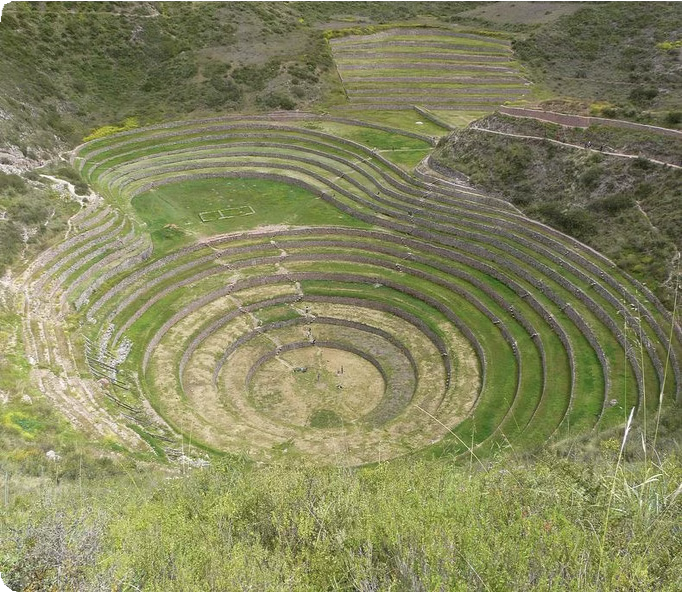
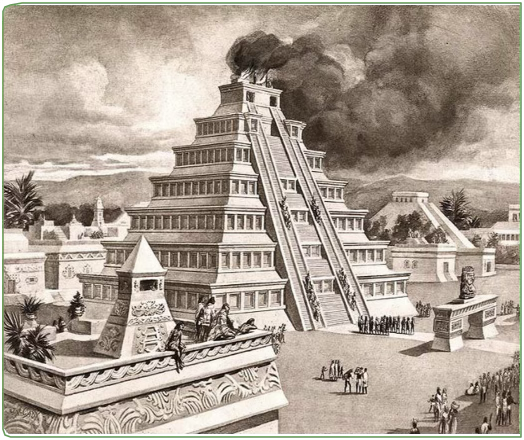
Fig 1.16: An inca architecture
Study the picture shown above and answer the following questions.
- In your own words describe how farming in Inca civilisation was done with reference to this source.
- Would the Inca farming system be useful in your own community or other parts of South Sudan?
- Explain why.
Their art is also seen in their art work of pottery, weaving and textile materials. They had good designs of serpents, fish, diamonds, squares, birds and crabs on their textile materials.
They painted their bodies with soil when gracing social ceremonies and important occasions.
Impact of Inca’s early civilisation to science and technology Not much of the early inventions of the Incas has been used recently. The Inca did not have money, they did not use the wheel for transport, no iron working and no writing method for keeping records. However, they had the following achievements:
- They had an elaborate road network used to transport trade items, move troops and communication. Messengers were the main method of communication. Messengers passed information verbally or by the use of Quipu.
- They used irrigation and water storage techniques to ensure crops flourished all-seasons.
- The stone buildings were also a good piece of technological advancement. They used strong mortar to hold stones together and come up with a strong building.
- Their calendar has been used to modify the modern day calendar.
- Their tax system was also an idea that the government used to provide essential services. Many officials were kept in charge of tax collection.
The fall of the Inca civilisation.
- Arrival of Spanish and Disease: The Incas' decline began with the arrival of Spanish explorers, who introduced foreign diseases like smallpox.
- Political Crisis: Smallpox killed Emperor Huayna Capac and his successor around 1525, causing political turmoil as his sons, Atahualpa and his half-brother, fought for power. Atahualpa eventually won and became the new Emperor.
- Spanish Conquest:
- News of the Incas' wealth attracted the Spanish conquistador (Conqueror) Francisco Pizarro.
- In 1532, Pizarro lured Atahualpa to a dinner meeting and subsequently killed him.
- Military Defeat: Using their superior weapons, the Spanish attacked and defeated the Incas at the capital, Cusco, in 1533, ending the main empire.
- Continued Resistance:
- The Spanish installed a puppet ruler, Manco Inca Yupanqui.
- Local resistance was strong in 1536, forcing Manco Inca to retreat to the village of Vilcabamba.
- Final Collapse: This chain of events ultimately led to the final collapse of the Inca Empire.
Discuss what the modern African societies can learn from the Inca’s civilisation. Present your answers in class.
- Civilisation: The stage of human social development and organisation considered to be most advanced.
- Evolution: The gradual development of a thing. Kingdom:A territory ruled by a king.
- Empire: Several countries or states ruled by a single sovereign.
- Dynasty: A line of hereditary rulers a territory.
- Garrison: A group of soldiers living in a certain area in order to defend it.
- Monarchy: This refers to territories in which authority is vested on a single person particularly a king, queen or emperor.
Analyse how the Egyptians in their ancient civilisation practised mummification. Examine the buildings in your school.
Find out if these buildings have borrowed their architecture from ancient civilisations.
Analyse how ancient civilisations’ architecture have influenced buildings in our modern cities and towns. Based on the land surrounding the Nile River, discuss why you think the old Egyptian claim stated that Nile gives life to Egypt. Modern building and decoration technique has allowed us to build the sky scrapers that dominate our skyline.
Describe how the Chinese made houses look like and why.
Check the notes you made at the beginning of this unit.
Were your hopes and expectations fulfilled?
End of Unit 1 Exercise